Select your tailored shipping lane or sourcing fulfillment plan below. Every product route is fully managed with real-time tracking, custom clearance, and landed-cost transparency.
Why leading global importers, enterprise brand networks, and e-commerce aggregators partner with Asiana USA and our Asia-pacific supply chain infrastructure.
With fully staffed ground offices across major industrial clusters in China (Shenzhen, Guangzhou, Ningbo, Shanghai), Vietnam, and Bangladesh, we inspect cargo, verify supplier packing, and handle export clearance at the factory gate.
Headquartered in Los Angeles with secondary hub management in New York, we handle complex port drayage, cross-docking, and transloading straight from key US West Coast and East Coast terminals to prevent costly demurrage.
We eliminate friction for North American and European buyers by turning factory-gate FOB quotes into fully compliant DDP deliveries, consolidating ocean freight, customs brokerage, HTS classification, and final-mile trucking into a single invoice.
Evaluating operational risk, cost predictability, and regulatory compliance for cross-border China procurement.
| Procurement Parameter | Standard FOB (Free On Board) | Managed DDP (Delivered Duty Paid) | Asiana USA Enterprise Model |
|---|---|---|---|
| Freight & Customs Accountability | Split between origin supplier & US buyer | Single logistics provider ownership | End-to-End Single-Point Accountability |
| Landed Cost Risk Exposure | High (Unexpected demurrage, port fees) | Fixed upfront landed cost quote | Guaranteed fixed landed cost + HTS audit |
| US Customs Entry Compliance | Buyer handles ISF, Bonds, Duty filings | Agent handles clearance & duties | In-house Licensed Customs Brokerage |
| FBA / Distribution Readiness | Requires third-party prep center | Direct warehouse delivery | Direct FBA appointment + Staging storage |
As global commerce undergoes unprecedented structural realignments, purchasing executives, sourcing directors, and supply chain managers are forced to re-evaluate their reliance on single-country manufacturing setups. China remains the undisputed heavyweight of global industrial output, accounting for over 28% of world manufacturing capacity. However, the operational playbook for sourcing from a Top China Supply Chain Factory & Supplier has shifted dramatically from basic labor-cost arbitrage to sophisticated digital integration, regulatory compliance, and total landed-cost optimization.
This industry report explores the systemic shifts shaping China's manufacturing clusters, product procurement dynamics, regulatory customs challenges, and strategic solutions for maintaining high profit margins when importing into North American and European markets.
Historically, western buyers treated Chinese manufacturing suppliers as contract assemblers operating on strict OEM (Original Equipment Manufacturer) specifications. Today, the competitive edge lies in leveraging China's mature ODM (Original Design Manufacturer) ecosystems. Industrial clusters in Guangdong (Shenzhen, Dongguan, Guangzhou) and Zhejiang (Ningbo, Yiwu, Hangzhou) have vertically integrated raw material processing, component manufacturing, rapid prototyping, and automated testing under localized geographic hubs.
Key developments buyers must account for when auditing tier-1 suppliers include:
Modern global procurement is no longer defined by simple FOB factory quotes. Cross-border buyers face volatile tariffs (Section 301 duties), fluctuating ocean container rates, strict Amazon FBA warehouse receiving limits, and tight retail inventory turnover schedules. To succeed, top-tier importers are adopting four strategic supply chain methodologies:
Rather than completely abandoning Chinese manufacturing infrastructure—which possesses unparalleled sub-tier component availability—leading brands utilize a hybrid model. Primary components and high-precision parts are manufactured in specialized China hubs, then exported to secondary regional hubs in Vietnam or Bangladesh for final assembly and packaging. This mitigates single-region geopolitical risk while maintaining cost efficiency and quality control.
Buying on traditional Free On Board (FOB) terms leaves overseas buyers responsible for arranging ocean freight, managing port drayage, filing Importer Security Filings (ISF), procuring customs bonds, and coordinating final truckload dispatches. Forward-thinking companies are partnering with integrated logistics specialists like Asiana USA to execute seamless DDP (Delivered Duty Paid) shipping. Under this framework, duty payments, customs brokerage clearance, ocean freight, and door delivery are consolidated into a predictable landed cost, protecting gross profit margins against surprise port demurrage or detention charges.
Modern supply chains demand live telematics. Advanced freight forwarders now equip ocean containers and air freight pallets with IoT sensors that measure real-time GPS position, temperature variations, humidity levels, and shock alerts. This data integration gives procurement teams exact Estimated Time of Arrival (ETA) updates, enabling just-in-time inventory replenishment for retail stores and fulfillment centers.
Importing goods from a China factory into the United States requires navigating complex legal, financial, and regulatory compliance rules set by U.S. Customs and Border Protection (CBP). Mistakes in product classification can lead to retroactive duty audits, cargo seizures, and severe financial penalties.
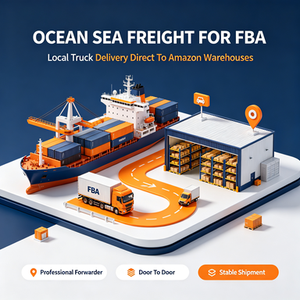
For cross-border e-commerce brands and Amazon sellers, supply chain speed and delivery precision directly dictate seller ranking and Buy Box ownership. Transporting goods from factory floors in Shenzhen or Ningbo directly to Amazon FBA fulfillment centers across North America demands strict compliance with Amazon's inbound box dimensions, palletization standards, and FNSKU labeling requirements.
By leveraging dedicated cross-docking hubs near major ports like Los Angeles and Long Beach, importers can store safety stock domestically in low-cost regional warehouses, using automated drip-feeding algorithms to restock Amazon FBA warehouses via local freight truckload (LTL/FTL) as inventory levels dip. This hybrid approach avoids Amazon's steep long-term storage fees while insulating the business against stockouts caused by ocean port congestion.
Sourcing agriculture, food products, chemical reagents, or temperature-sensitive consumer items from Asia requires specialized cold-chain logistics protocols. Temperature spikes during port transfer or vessel loading can spoil entire shipments. Professional logistics forwarders mitigate cold-chain breakdown by deploying smart reefer (refrigerated) containers equipped with automated atmosphere monitoring, priority port drayage dispatch, and expedited customs inspection channels.
Clear, actionable answers to essential questions asked by international buyers, global supply chain directors, and e-commerce importers.
Connect directly with our senior supply chain directors and licensed US customs specialists. Get custom landed-cost quotes, route audits, and tailored DDP logistics plans today.
Get a Quote